Donald Trump has made clear that his agenda for Venezuela has more to do with oil than drug trafficking or alleged narcoterrorism.
He even claims he alerted oil executives shortly before U.S. troops entered the country on January 3, despite never informing Congress.
But Venezuela’s oil may be a distraction. Professionals in the oil industry are speaking out AGAINST Trump’s plan.
Insiders gave CNN a handful of reasons their companies won’t rush into Venezuela, including long-term political instability in the country. But the most important reason is the financial burden.
Oil companies said: “Oil prices are too low today to justify spending the gobs of money – possibly tens of billions of dollars – that would be required to revive Venezuela’s decaying oil industry.”
Talk inside the industry is that if Trump did speak to oil executives before last week’s operation, they would have told him not to go through with it.
The only exception may be Paul Singer, a Trump mega-donor whose investment firm acquired CITGO in November. CITGO is the U.S. subsidiary of Venezuela’s state-run oil company.
Many believe Trump used the military as a favor for Singer, but that seems unlikely since the administration spent all of last year fabricating justifications for this operation.
Go further back than November, and the only Trump ally that was prepared for a U.S. takeover of Venezuela (and supports Trump’s desire to take Cuba and Greenland next) is Russia.
Since 2017, the Russian government has pushed the idea of a trade with the United States. Trump would take control over Venezuela, a Russian military and energy partner, and disengage the U.S. from Ukraine, allowing Russia to take it.
This idea was mostly meaningless until early 2019, when Trump quietly ordered the CIA to devise a plan for regime change in Venezuela.
Months later, Fiona Hill, Trump’s senior director for European and Russian affairs at the National Security Council (NSC), told Congress that this was Russia’s plan.
“They were trying to set up some kind of, let’s just say, ‘You stay out of Ukraine or you move out of Ukraine, you change your position on Ukraine, and, you know, we’ll rethink where we are with Venezuela.’”
She also revealed that Russia had made preparations for U.S. action in Venezuela, and Trump’s personal attorney, Rudy Giuliani, was working with men who were aware of Putin’s plan.
The NSC and the State Dept. sent Hill to Russia that summer to tell the Kremlin to “knock it off,” and U.S. agencies refused to help the CIA overthrow Maduro.
But with the second Trump administration packed with Trump loyalists and Russian assets, there was no one to stop him from following through this time.
Trump is now threatening to invade at least six more countries, which would solidify the broader goal of Putin’s proposal: Russia supports U.S. dominance over the Western hemisphere and the U.S. cuts ties to countries on the other half of the globe.
A world map that splits the globe between the US, Russia, and China..
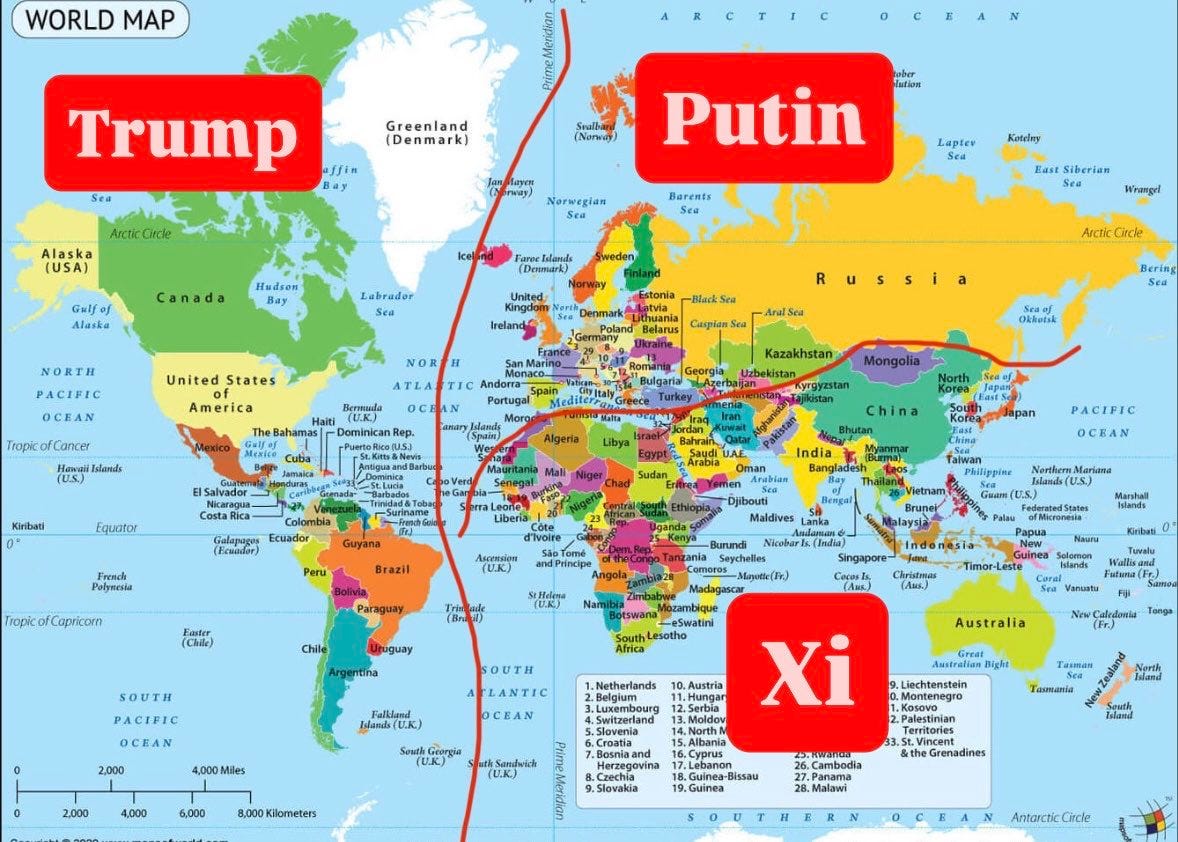
This plan for Trump 2.0 was foreshadowed during Trump and Putin’s August summit in Alaska, but articles dating back to April describe it, too.
If you need more evidence that interfering in Venezuela goes beyond oil, look to the administration’s own social media accounts. The Trump regime is not just a threat to democracy and our national security. It’s a Kremlin-backed threat to global stability and alliances that have protected us from World War III for nearly 100 years.
TrumpFile.org